


Football betting generates billions in turnover each year, yet a surprising number of punters place wagers without truly understanding what the numbers on their screen actually mean. Those seemingly random figures next to team names are not decorative elements. They represent the distilled probability of an outcome, adjusted by bookmakers to ensure their profit margin. If you cannot read and interpret betting odds fluently, you are navigating a foreign country without speaking the language.
This guide will transform you from someone who vaguely understands that bigger numbers sometimes mean bigger payouts into a bettor who can glance at any odds format and immediately grasp what it implies about probability, potential return, and value. We will cover the three dominant odds formats worldwide: American, Decimal, and Fractional. You will learn how to calculate payouts, convert between formats, and extract the implied probability that bookmakers price into every line.
The ability to read odds properly separates recreational bettors from those who approach football wagering as a skill-based endeavor. Markets move, lines shift, and opportunities disappear within minutes. Those who hesitate because they need to double-check what +175 means will consistently miss the best value. Understanding odds is the foundation upon which every other betting skill is built.
Understanding Football Betting Odds

At their core, football betting odds serve two simultaneous purposes that are easy to conflate but important to distinguish. First, they represent the bookmaker’s assessment of probability for a given outcome. Second, they dictate the payout structure should that outcome occur. These two functions are related but not identical, and understanding the gap between them is where sharp bettors find their edge.
When a sportsbook posts odds on Manchester City to beat Brighton, they are not simply predicting what will happen. They are pricing a market designed to attract action on both sides while building in a margin that guarantees profit over time. The odds you see have already been adjusted to include this margin, commonly called the overround, vigorish, or simply the vig. This means the implied probabilities of all outcomes in a market will sum to more than 100%, typically somewhere between 102% and 110% depending on the bookmaker and the market’s liquidity.
Bookmakers employ teams of odds compilers who combine statistical models, historical data, injury reports, team news, and market sentiment to generate opening lines. Once those lines hit the market, they become living organisms. Sharp bettors who identify mispriced odds attack them immediately, causing lines to move. Public money, which tends to favor favorites and popular teams, can push lines in the opposite direction. The odds you see at any given moment represent the current equilibrium point between all these forces plus a house edge.
Understanding this distinction matters because it reframes your entire approach to betting. You are not trying to predict whether a team will win. You are trying to determine whether the probability implied by the odds is lower than the true probability of that outcome. If the market says Manchester City has a 65% chance of winning but your analysis suggests 72%, you have found value regardless of whether City actually wins that particular match. This is the fundamental insight that separates gambling from advantage betting.
American Odds Format Deep Dive
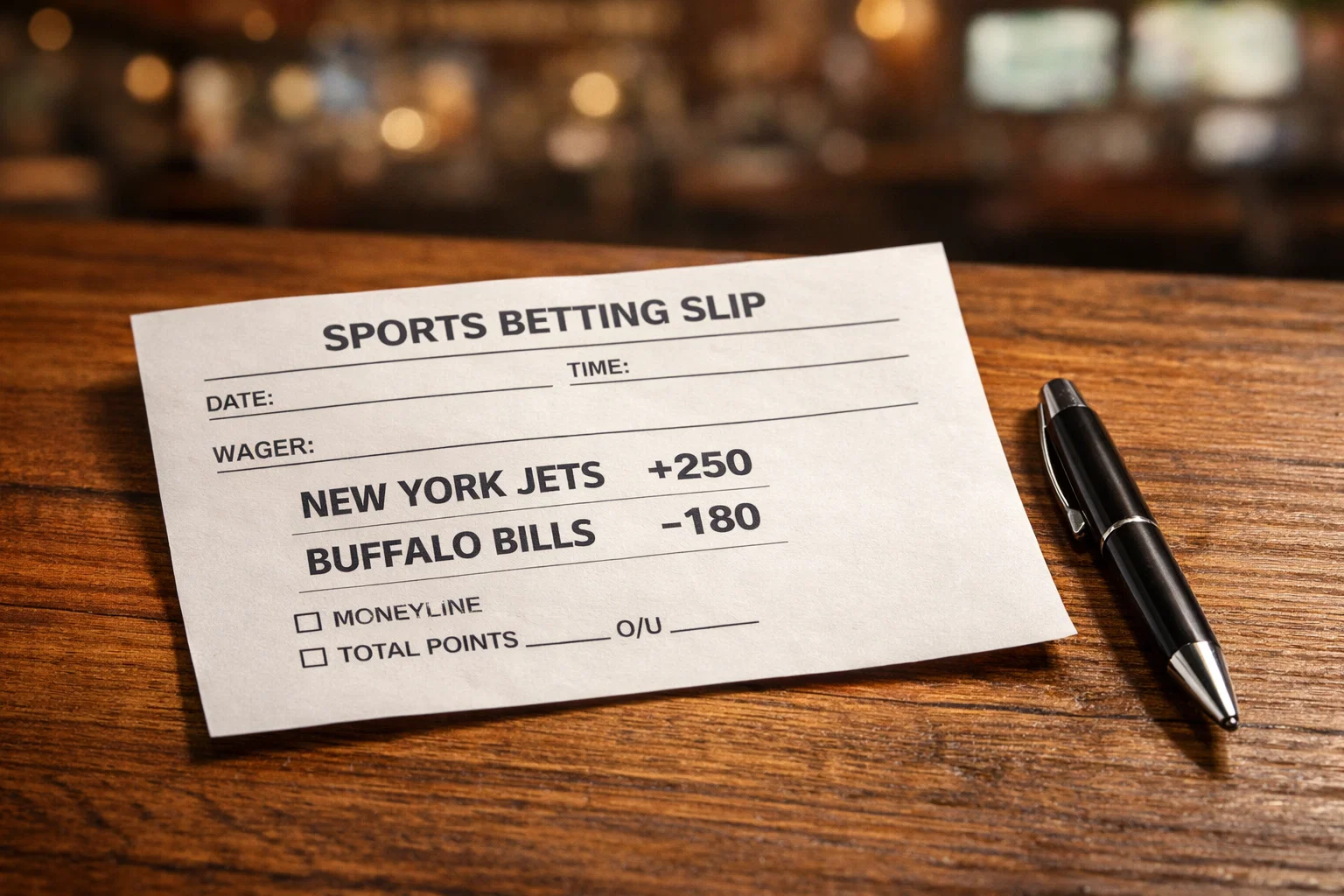
American odds are the standard format used by sportsbooks in the United States, and they initially confuse almost everyone who encounters them. The format uses positive and negative numbers centered around a baseline of 100, and the sign indicates whether you are looking at a favorite or an underdog. Once you internalize the logic, American odds become just as readable as any other format, but the learning curve is steeper than for decimal odds.
Positive Odds (+) Explained
Positive American odds indicate an underdog and tell you how much profit you would earn on a $100 stake. When you see +250 next to a team, the market is saying: place $100 on this outcome, and if it wins, you collect $250 in profit plus your original $100 stake back. The total return would be $350. The higher the positive number, the bigger the underdog and the larger your potential profit.
The plus sign means you are being offered plus money on top of your stake. At +250, you are getting two and a half times your money in profit. The baseline is always $100, which provides a clean reference point for quick mental calculations. If you want to know your profit on a different stake, just scale proportionally. A $50 bet at +250 yields $125 profit.
Positive odds become particularly relevant when evaluating underdogs and draw outcomes in football. Unlike American sports where draws are impossible or rare, football’s three-way market means the draw is always priced and often carries significant positive odds. A draw at +220 is telling you the market believes a tie happens less than one-third of the time, but the payout is substantial when it does occur. Many successful bettors specialize in identifying draws that are undervalued by the market.
Negative Odds (-) Explained
Negative American odds indicate a favorite and tell you how much you must stake to win $100 in profit. When you see -180 next to a team, the market is saying: wager $180, and if this team wins, you collect $100 profit plus your $180 stake back. The total return would be $280. The larger the negative number, the heavier the favorite and the more you must risk to win that benchmark $100.
This structure can feel counterintuitive at first because you are flipping the reference point. With positive odds, you know your stake ($100) and solve for profit. With negative odds, you know your target profit ($100) and solve for required stake. But the underlying principle is identical: the number is always tied to $100 as a reference unit.
Heavy favorites in football often carry very large negative numbers. A top club facing a struggling relegation candidate might be priced at -500 or lower, meaning you would need to risk $500 to profit $100. Many recreational bettors pile onto heavy favorites thinking they are easy wins, only to discover that the occasional upset wipes out many successful bets worth of profits. A team at -500 needs to win more than 83% of the time for bets on them to break even long-term.
Calculating Payouts Step-by-Step
For positive odds, the calculation is straightforward. Multiply your stake by the odds divided by 100, then add your stake back. If you bet $75 at +200, your profit is $75 times 2, which equals $150. Your total return including stake is $225.
For negative odds, divide 100 by the absolute value of the odds, then multiply by your stake to find profit. If you bet $150 at -120, your profit is 100 divided by 120 (approximately 0.833) multiplied by $150, which equals about $125. Your total return including stake is $275.
The easiest way to remember this is that American odds tell you a ratio relative to $100. Positive odds tell you profit per $100 staked. Negative odds tell you stake required per $100 profit. Once this ratio clicks in your mind, you can quickly estimate returns without a calculator.
Real Match Examples
Consider a Premier League match between Liverpool and Everton with odds listed as Liverpool -145, Draw +260, Everton +380. These numbers immediately tell you that Liverpool is the favorite but not an overwhelming one. A $145 bet on Liverpool profits $100 if they win, giving a total return of $245. The draw at +260 would profit $260 on a $100 bet if neither team wins in regulation. Everton at +380 is the clear underdog, but a successful $100 bet would return $480 total.
In a Champions League fixture, you might see Paris Saint-Germain at -220 against a mid-table Bundesliga side priced at +550, with the draw at +350. PSG is a heavier favorite here, requiring a $220 stake to profit $100. But the underdog payout is substantial, and the draw remains a viable betting option for those who expect a tight match.
Reading these odds instantly tells you not just who the market favors but by how much, allowing you to quickly assess whether the prices align with your own analysis of the matchup.
Decimal Odds Format Explained
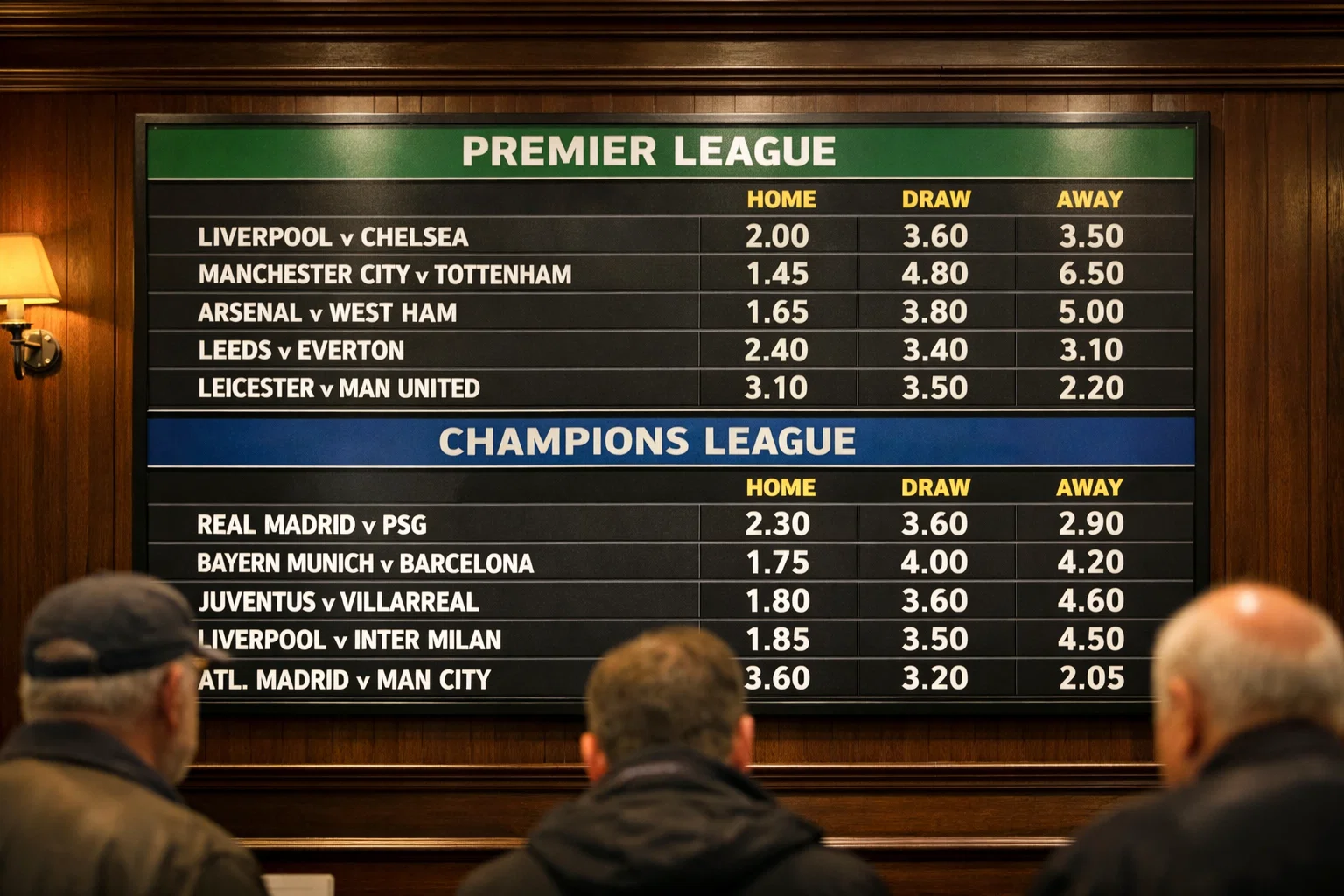
Decimal odds dominate in Europe, Australia, and increasingly on international betting platforms that cater to a global audience. Many bettors find decimal odds more intuitive than American odds because the number directly represents your total return per unit staked. There is no need to distinguish between favorites and underdogs using positive and negative signs.
How Decimal Odds Work
With decimal odds, the number you see is exactly what you multiply by your stake to calculate total return. If the odds are 2.50 and you bet $100, your total return is $250. This includes both profit and original stake. To isolate profit, simply subtract 1 from the decimal odds and multiply by your stake.
The baseline for even money in decimal format is 2.00. At this number, you double your money if you win. Anything below 2.00 represents a favorite, and anything above represents an underdog. A heavy favorite might be priced at 1.15, meaning a $100 bet returns only $115 total. A longshot underdog might sit at 12.00, meaning that same $100 bet returns $1,200 total.
This uniformity makes decimal odds particularly useful for comparing prices across different outcomes or different sportsbooks. If one book has Manchester United at 1.85 and another has them at 1.90, you immediately know the second book is offering better value without any format conversion needed.
Calculating Returns
Calculating returns with decimal odds is the simplest operation in sports betting mathematics. Take your stake, multiply by the decimal odds, and you have your total return. A $50 bet at 3.40 returns $170. A $200 bet at 1.65 returns $330. The formula never changes regardless of whether you are betting on favorites, underdogs, or draws.
To calculate profit alone, multiply your stake by the decimal odds minus one. That same $50 bet at 3.40 yields profit of $50 times 2.40, which equals $120. This is simply your total return of $170 minus your original stake of $50.
For accumulator bets where you combine multiple selections, decimal odds shine even brighter. Simply multiply all the decimal odds together, then multiply by your stake. If you combine three selections at 1.80, 2.20, and 1.50, your cumulative odds are 1.80 times 2.20 times 1.50, which equals 5.94. A $10 accumulator at those combined odds returns $59.40 if all three selections win.
Popularity and Practical Use
European sportsbooks almost universally default to decimal odds, and this format has become the international standard on exchanges like Betfair. The mathematical simplicity appeals to bettors running their own models. When your primary tool for finding edge is a spreadsheet calculating expected value, decimal odds slot directly into formulas without requiring conversion.
Australian bookmakers also embraced decimal odds early. In recent years, even American sportsbooks have started offering decimal odds as an alternative display option, recognizing that many customers prefer the format. If you plan to bet with multiple international sportsbooks or use betting exchanges, fluency in decimal odds is essentially mandatory.
Consider a Serie A match with the following decimal odds: Juventus 1.70, Draw 3.60, Napoli 4.75. These prices tell you that Juventus is favored but not heavily, the draw carries solid value if you believe the teams are evenly matched, and Napoli winning would be considered an upset. A $100 bet on Juventus returns $170 total. The same bet on the draw returns $360. Backing Napoli returns $475.
Fractional Odds Format
Fractional odds represent the oldest format still in widespread use, deeply rooted in British horse racing tradition and still popular in UK football markets. While many younger bettors and online platforms have shifted toward decimal odds, you will still encounter fractional odds regularly when dealing with British bookmakers or consuming UK sports media.
Reading Fractional Odds
Fractional odds express the ratio of profit to stake. When you see odds of 5/2, this means for every 2 units you stake, you profit 5 units if the bet wins. Your total return would be 7 units: your 5 units of profit plus your original 2 unit stake returned.
The numerator (top number) represents potential profit. The denominator (bottom number) represents the stake required. When the numerator is larger than the denominator (like 5/2 or 3/1), you are looking at an underdog. When the denominator is larger (like 1/2 or 4/9), you are looking at a favorite. Even money is expressed as 1/1, sometimes written as “evens” in British parlance.
Reading fractional odds becomes second nature with practice, but the format is admittedly less immediately intuitive than decimal odds. You need to perform a division in your head to understand the actual multiplier, whereas decimal odds give you the multiplier directly.
Calculation Method
To calculate total return from fractional odds, divide the numerator by the denominator, add 1, then multiply by your stake. At odds of 7/4, you divide 7 by 4 to get 1.75, add 1 to get 2.75, and multiply by your stake. A $40 bet at 7/4 returns $110 total, which includes $70 profit plus your $40 stake.
To calculate profit only, simply divide the numerator by the denominator and multiply by your stake. That same $40 bet at 7/4 yields profit of 1.75 times $40, which equals $70.
For odds where the denominator exceeds the numerator (favorites), the same formula applies but yields smaller returns. At 4/7, you divide 4 by 7 to get approximately 0.571. A $70 bet at 4/7 yields profit of about $40, for a total return of $110.
UK Tradition and Usage
Fractional odds remain culturally embedded in British betting, particularly in horse racing but also in football markets offered by traditional UK bookies. Terms like “ten to one” or “five to two” are part of the betting vernacular in Britain. When you walk into a British betting shop, the prices displayed will almost certainly be in fractional format.
That said, the trend clearly favors decimal odds even in the UK. Online platforms increasingly offer decimal as the default with fractional available in settings. Younger British bettors often prefer decimal, having grown up with international platforms and exchanges. Fractional odds are not disappearing, but their dominance in British football betting has faded.
Understanding both formats ensures you can consume odds from any source without confusion. Whether reading a British newspaper’s match preview or checking Asian handicap lines on an international exchange, format fluency keeps you informed.
Converting Between Odds Formats
Fluency in all three major odds formats requires being able to convert between them seamlessly. Whether you are line shopping across international sportsbooks or simply trying to understand odds quoted in an unfamiliar format, conversion skills are essential.
American to Decimal
Converting positive American odds to decimal: divide the American odds by 100 and add 1. At +250, you divide 250 by 100 to get 2.5, then add 1 to get 3.50 decimal.
Converting negative American odds to decimal: divide 100 by the absolute value of the American odds, then add 1. At -150, you divide 100 by 150 to get approximately 0.667, then add 1 to get 1.67 decimal.
These formulas derive from the fundamental definitions of each format. Positive American odds tell you profit per $100 staked, so dividing by 100 gives you profit per $1, and adding 1 accounts for getting your stake back.
Decimal to Fractional
Converting decimal odds to fractional requires expressing the decimal as a fraction. Subtract 1 from the decimal odds, then express the result as a fraction. Decimal odds of 3.00 become 3.00 minus 1 equals 2, which is 2/1. Decimal odds of 2.50 become 1.50, which is 3/2. Decimal odds of 1.50 become 0.50, which is 1/2.
Some decimal values produce messier fractions. Decimal odds of 2.75 become 1.75, which is technically 7/4. Odds of 2.10 become 1.10, which is 11/10. British bookmakers typically round these to common fractions.
While mental conversion is valuable for quick estimates, most bettors keep conversion tools bookmarked. Many sportsbooks allow you to toggle between formats in your account settings.
Implied Probability Explained
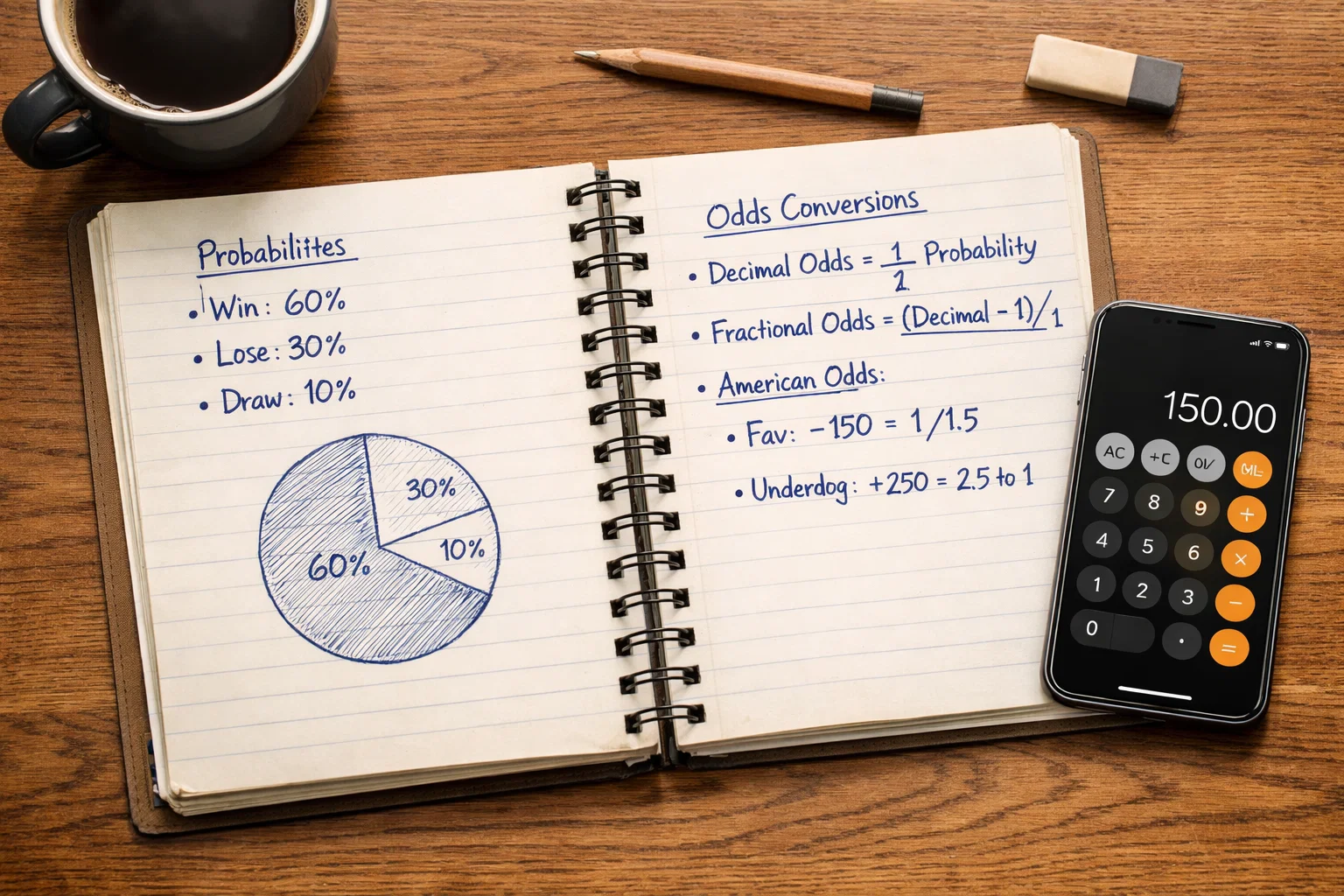
Implied probability is perhaps the most important concept for bettors who want to move beyond simply understanding payouts toward actually finding value in the markets. Every set of odds encodes a probability estimate, and extracting that estimate allows you to compare the bookmaker’s assessment against your own.
What Is Implied Probability
Implied probability is the probability of an outcome that would make a bet break even over the long run at the given odds. If a team is priced at 2.00 decimal odds, the implied probability is 50%. This means if that team won exactly half the time, you would neither profit nor lose money betting on them at those odds over many repetitions.
The term “implied” is crucial. This is not necessarily the true probability of the outcome. It is the probability baked into the price, which includes the bookmaker’s margin. The bookmaker believes the team has perhaps a 48% true probability but prices them as if they have a 50% chance to ensure profit. Your job as a bettor is to determine when implied probability underestimates true probability.
Understanding implied probability transforms how you view odds. Instead of just seeing that a team pays 3.50 if they win, you see that the market is pricing them at roughly 28.6% to win. You can then ask: do I believe this team wins more than 28.6% of the time? If yes, there may be value in the bet.
Conversion Formulas
For decimal odds, the formula is simple: implied probability equals 1 divided by the decimal odds. At decimal odds of 2.50, implied probability is 1 divided by 2.50, which equals 0.40 or 40%.
For positive American odds: implied probability equals 100 divided by (American odds plus 100). At +200, implied probability is 100 divided by 300, which equals 0.333 or 33.3%.
For negative American odds: implied probability equals the absolute value of the American odds divided by (absolute value plus 100). At -150, implied probability is 150 divided by 250, which equals 0.60 or 60%.
Finding Value Through Probability
Value exists when the true probability of an outcome exceeds its implied probability. If you assess a team’s win probability at 45% but the market prices them at 35% implied probability (decimal odds around 2.85), you have found value. Betting on this team is positive expected value even though they lose more often than they win.
This concept is difficult for many recreational bettors because it separates the outcome of individual bets from the quality of those bets. A value bet can lose, and a negative value bet can win. What matters is whether your assessment of probability was accurate across many bets. If you consistently identify situations where true probability exceeds implied probability, you will profit over time.
The practical challenge is estimating true probability accurately, which requires knowledge, research, and sometimes quantitative modeling. But even without sophisticated models, understanding implied probability helps you avoid obvious traps. When you see a heavy favorite priced at -400, you immediately know the implied probability is 80%. You can then ask if that team really does win 80% of such matches.
How Odds Movement Works

Odds are not static numbers etched in stone when a market opens. They move continuously in response to information and money flow. Understanding why and how odds move can help you time your bets more effectively.
Why Odds Change
The most fundamental driver of odds movement is betting volume and distribution. When disproportionate money flows to one side of a market, bookmakers adjust the odds to attract action on the other side. If everyone hammers Liverpool at -130, the sportsbook might move them to -145 to reduce exposure and encourage bets on the opponent.
Information causes odds movement as well. Team news about injuries, lineup decisions, or suspensions will immediately shift odds as markets adjust to new expectations. Weather changes, venue alterations, and even social media rumors can trigger movement. Markets are remarkably efficient at incorporating information, which is why acting quickly on genuine insights matters.
Sharp bettors cause significant odds movement when they place large wagers. Sportsbooks pay close attention to accounts with winning track records, and when these accounts take a position, the books move the line preemptively. This “steam” can cascade across the entire market within minutes.
Sharp Money and Steam Moves
When multiple sportsbooks simultaneously move their lines in the same direction within a short window, this is called a steam move. Steam typically originates from sharp bettors hitting the market with significant money. If you see odds on an underdog move from +240 to +210 across several books within ten minutes, sharps have likely identified value.
Some bettors try to follow steam moves, quickly betting on the same side as the sharps before prices move further. This strategy has diminishing returns because you are getting worse odds than the sharps did. However, tracking steam moves can serve as a useful signal that something is happening in a market that warrants attention.
The term “sharp money” refers to bets from sophisticated bettors with winning records, as opposed to “public money” from recreational bettors who favor favorites and popular teams. Books distinguish between these groups and weight their odds adjustments accordingly.
Line Shopping Benefits
Because odds vary across sportsbooks and move at different speeds, line shopping can significantly improve your long-term results. Getting +155 instead of +145 on the same bet is pure value that requires no additional skill or insight.
Over hundreds of bets, the cumulative benefit of consistent line shopping often exceeds the edge you gain from improved handicapping. Professional bettors treat line shopping as non-negotiable, maintaining accounts at numerous sportsbooks and using odds comparison tools to see where the best price sits.
For recreational bettors, even basic line shopping across two or three books can make a meaningful difference. Simply having alternatives and taking thirty seconds to compare before confirming a bet can turn marginally profitable betting into solidly profitable betting over time.
Conclusion
Reading and calculating football betting odds is a fundamental skill that every serious bettor must master. The three main formats, American, Decimal, and Fractional, each present the same underlying information in different ways. American odds use positive and negative numbers relative to a $100 baseline. Decimal odds show your total return multiplier directly. Fractional odds express profit relative to stake as a ratio.
Beyond mechanical reading, the deeper skill lies in extracting implied probability from any odds format and comparing it against your own assessment of true probability. This is where value is found and long-term profitability becomes possible. A bet that pays 3.00 is not inherently good or bad. It depends entirely on whether the 33% implied probability underestimates or overestimates the actual likelihood.
Odds move in response to money flow and information, creating both challenges and opportunities. Sharp bettors who act quickly on genuine insights capture value before lines adjust. Line shopping across multiple sportsbooks ensures you always get the best available price. This foundation will serve you well as you develop more advanced handicapping and strategy skills.
