

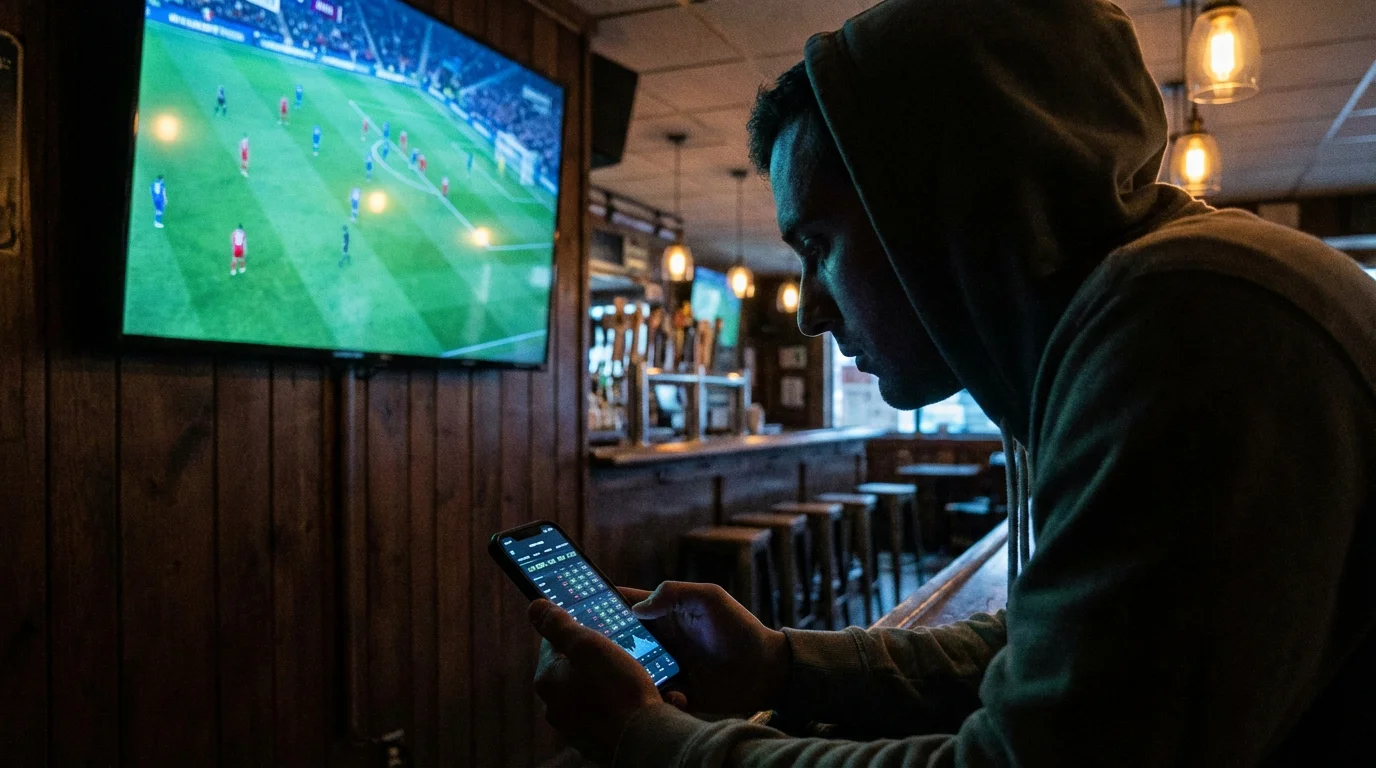
Pre-match betting is a snapshot. You analyze the matchup, place your wager, and wait. Live betting is a movie. The odds are shifting in real time, reacting to goals, red cards, injuries, and the visible momentum of the game unfolding in front of you. It is faster, more chaotic, and — when approached with discipline — potentially more rewarding than anything you can do before kickoff.
In-play betting now accounts for a massive share of total handle at most major sportsbooks. The market has grown because it combines the analytical challenge of pre-match wagering with the immediacy of watching the action. But that immediacy is also the trap. Live betting rewards patience and punishes impulse, and the margin between the two is often measured in seconds.
Analyzing Live Odds Movement
Live odds are not set by human traders watching the game with a cup of coffee. They are generated by algorithms that ingest data feeds — score changes, time elapsed, possession stats, expected goals — and recalculate probabilities multiple times per minute. The human oversight layer exists mainly to handle edge cases and halt markets during goals or controversial incidents.
The most dramatic odds movements happen around goals. When the underdog scores first in a soccer match, the favorite’s live moneyline odds lengthen immediately, often dramatically. A pre-match favorite at 1.50 might jump to 2.50 or higher after conceding. This creates a window of opportunity if you believe the favorite will equalize — but that window can also be a trap if the goal reflected a genuine shift in the game’s dynamics rather than an isolated event.
Red cards produce the second-biggest shifts. A team reduced to 10 men sees its odds worsen across every market — moneyline, spread, and totals. The magnitude of the shift depends on the timing (a red card at minute 20 is more impactful than one at minute 80) and the score (a red card while leading 2-0 matters less than one at 0-0). Smart live bettors know that the market sometimes overreacts to red cards, especially late ones where the disadvantage has minimal time to manifest.
Injuries, substitutions, and tactical changes also move the line, but more subtly. A star striker limping off at halftime will shift the goalscorer and totals markets. A manager switching from a 4-3-3 to a 5-4-1 signals defensive intent that should, in theory, push the under. These adjustments happen continuously and are baked into the algorithm’s output, but the speed and accuracy of the adjustment varies by sportsbook — which is where edges can appear.
Reading Momentum in Real Time
The word “momentum” gets thrown around carelessly in sports commentary, but in live betting it has a concrete meaning: visible changes in the pattern of play that suggest a shift in which team is more likely to score next.
Possession alone is a weak indicator. A team can dominate possession without creating genuine chances — this is especially common when a team is chasing the game and the opponent is happy to sit deep and absorb pressure. What matters more than possession is the quality and frequency of chances being created. If one side has rattled off three shots on target in five minutes, the live under might be in trouble regardless of what the ball-possession graphic says.
Expected goals (xG) tracking during a match offers a more rigorous measure of momentum. Several live data providers now offer real-time xG feeds, and comparing the xG accumulation rate of each team can tell you whether the scoreline reflects the balance of play. A match sitting at 0-0 but with a combined xG of 2.5 is a very different game from a 0-0 with a combined xG of 0.4. The first is a goalless match on borrowed time; the second is a genuine stalemate.
Set pieces — corners, free kicks in dangerous positions — are micro-events that signal attacking pressure. A flurry of corners for one team often indicates sustained territorial dominance. While individual corners convert to goals at a low rate (roughly 3-5% in most leagues), a cluster of them suggests the team is creating pressure that might manifest in open play as well.
Physical and emotional body language is an underrated input. If you are watching the match live, pay attention to how players react to mistakes, how quickly they transition from defense to attack, and whether the team structure holds shape during sustained pressure. These are subjective observations, but experienced live bettors develop a feel for when a team is about to crack — and the algorithm does not see body language.
Cash-Out Timing: When to Lock In and When to Hold
The cash-out feature is one of the most psychologically loaded tools in live betting. It allows you to close your bet before the event finishes, locking in a profit or cutting a loss. Used wisely, it is a legitimate risk management tool. Used emotionally, it is a guaranteed way to leave money on the table.
The fundamental question with cash-out is whether the current cash-out value is fair. Sportsbooks bake a margin into the cash-out price, which means you are almost always getting slightly less than the true expected value of your position. If your pre-match bet on Team A to win at 2.50 is now sitting at 1.30 in play because they are leading 2-0 at halftime, the cash-out offer will reflect Team A’s dominant position minus the sportsbook’s cut.
Cashing out makes sense when the game state has shifted in a way that materially changes the risk. If a key player gets injured and your bet now relies on a team that is significantly weakened, accepting the reduced cash-out value can be a rational decision. Similarly, if you bet an underdog at long odds and they are now winning but facing sustained pressure, taking profit before a likely equalizer is defensible.
Cashing out does not make sense when you are simply nervous. If your analysis was sound pre-match and the in-game dynamics support your position, closing early because of anxiety is trading expected value for emotional comfort. Over hundreds of bets, this habit will cost you. The discipline to sit through discomfort when the math is on your side is one of the hardest skills in live betting and one of the most valuable.
A useful framework: only consider cashing out when new information has emerged during the match that was not part of your pre-match analysis. A goal, a red card, a tactical switch, an injury — these are legitimate reasons to reassess. The clock ticking past the 70th minute while nothing has changed is not.
Common Live Betting Mistakes
Live betting amplifies every behavioral weakness that plagues pre-match bettors, and adds a few new ones. Recognizing these patterns in yourself is the first step toward eliminating them.
Chasing a losing pre-match bet. You placed a pre-match wager on Team A, they are losing 1-0 at halftime, and you double down with a live bet at adjusted odds. This is not strategy — it is denial. If your pre-match analysis was wrong, throwing more money at the same thesis in a worse position compounds the error. Every live bet should be evaluated as if you had no existing position on the match.
Betting during emotional peaks. The thirty seconds after a goal is scored is the worst time to place a live bet. The odds are adjusting, the market is volatile, and your own emotions — whether elation or frustration — are at their highest. Experienced live bettors wait for the market to stabilize, typically two to three minutes after a major event, before considering a new position.
Ignoring the time dimension. A 1-0 lead at minute 15 is fundamentally different from a 1-0 lead at minute 75. The team leading at minute 15 still has 75 minutes of exposure to conceding, while the team leading at minute 75 only needs to survive 15. Live odds reflect this, but casual bettors often underweight how much time changes probability. The closer you are to full time, the more extreme the odds become — and the more precisely you need to assess whether a comeback is realistic.
Overreacting to small samples of in-game data. Three minutes of sustained possession does not constitute a trend. A single counterattack does not mean the team is about to score. Live data is noisy, and pattern recognition in small samples is unreliable. The best live bettors wait for signals to accumulate — a ten-minute spell of dominance reflected in xG, multiple shots on target, visible fatigue in the opposition — before acting.
Placing too many bets. The continuous nature of live markets creates a temptation to bet constantly. Every minute presents a new price, a new micro-narrative, a new angle. Disciplined live bettors might place one or two in-play wagers per match. Undisciplined ones place ten or twelve, grinding their bankroll down through accumulated vig even if their directional reads are decent.
The Live Bettor’s Real Edge
The algorithms that set live odds are good — very good. They process data faster than any human and adjust probabilities with mechanical precision. You are not going to beat them on pure information speed. Your edge, if you have one, comes from contextual interpretation.
Algorithms know the score, the time, the possession stats, and the shot counts. What they model less precisely is tactical intent, emotional state, and situational context. A team that is 1-0 down at home in the 70th minute of a must-win match plays differently than the same team 1-0 down in a mid-season fixture with nothing at stake. The numbers look identical; the behavior does not. If you watch football closely enough to read those differences, and you are disciplined enough to act only when the discrepancy between algorithmic pricing and contextual reality is significant, live betting offers something pre-match analysis cannot: the chance to bet on what you see, not just what you expect.
