


The difference between a gambler and a bettor comes down to one word: strategy. Gamblers place wagers based on hunches, favorite teams, and the thrill of potential winnings. Bettors approach football markets with systematic methods designed to identify value and protect their bankroll over time. The first group occasionally wins but inevitably loses in the long run. The second group understands that consistent profitability requires treating betting as a discipline rather than entertainment.
This guide presents proven strategies used by serious football bettors who have moved beyond recreational wagering. We will cover value betting, the mathematical foundation of profitable wagering. We will examine the Kelly Criterion for optimal bet sizing and explore various bankroll management systems that keep you in the game through inevitable losing streaks. You will learn why specialization beats trying to cover every league and how statistical metrics can inform your decision-making.
None of these strategies guarantee wins on any individual bet. Football remains inherently unpredictable, and variance ensures that even the sharpest bettors endure losing months. What these approaches do provide is a framework for making decisions that tilt the odds in your favor over hundreds or thousands of wagers. They transform betting from a series of isolated gambles into a coherent system with measurable expectations.
Core Value Betting Strategy

Value betting is the single most important concept for anyone serious about long-term profitability in football wagering. Everything else, from bankroll management to specialization, supports this core principle. Without understanding value, you are simply hoping your predictions are accurate more often than the odds suggest. With understanding value, you can profit even when you are wrong more often than you are right.
What Is Value Betting
A value bet exists when the probability of an outcome is higher than what the odds imply. If you believe a team has a 50% chance of winning but the bookmaker prices them at odds implying only a 40% chance, you have found value. The bet is worth making regardless of whether this particular team wins this particular match because over many such bets, the mathematics favor you.
This concept separates betting from gambling at the fundamental level. Gambling focuses on whether a bet wins or loses. Value betting focuses on whether the price offered fairly represents the probability. A value bet that loses was still a good bet. A non-value bet that wins was still a poor bet. This reframing is uncomfortable for many recreational bettors who want the satisfaction of winning, but it is essential for anyone seeking long-term profit.
The bookmaker’s margin means that most bets offered to the public lack value. If the true probability of three outcomes in a football match is 45%, 28%, and 27%, the bookmaker might price them at implied probabilities of 47%, 30%, and 29%. The extra percentage points are the house edge. Finding value requires identifying specific spots where the bookmaker has mispriced an outcome relative to its true probability.
Identifying Value Bets
Finding value requires developing an accurate sense of what probabilities should be for various outcomes. This is where knowledge and research provide edge. If you understand that a particular team performs significantly better at home in night games, or that a manager’s tactical system consistently produces high-scoring matches against defensive opponents, you can identify when the market underestimates these factors.
Sharp bettors often develop their own probability models using historical data and statistical analysis. These models might incorporate team strength ratings, recent form, head-to-head records, rest days, travel distance, and dozens of other variables. The model outputs a probability for each outcome, which the bettor then compares against market odds. When the model probability exceeds the implied probability, a value opportunity exists.
Even without a formal model, bettors can identify value through deep knowledge of specific leagues or teams. Someone who watches every match of a lower-division German league might notice that the market consistently underestimates certain teams because fewer people are analyzing that competition. The information edge translates into value edge. A core component of any professional approach is mastering value betting in football to consistently identify overpriced markets.
Calculating Expected Value
Expected value (EV) quantifies the average return you can expect from a bet over the long run. The formula is simple: multiply the probability of winning by the potential profit, then subtract the probability of losing multiplied by the stake. Positive EV means the bet is profitable on average; negative EV means the bet loses money on average.
For example, if you believe a team has a 40% chance of winning and the decimal odds are 3.00, your expected value on a $100 bet is: (0.40 times $200 profit) minus (0.60 times $100 stake) equals $80 minus $60 equals $20 positive. This bet has positive expected value of $20 per $100 wagered, making it a strong value opportunity.
The challenge, of course, is that you never know the true probability with certainty. Your estimate might be wrong. This is why sample size matters so much in value betting. A single bet might lose even with massive positive EV. Over thousands of properly identified value bets, the results will converge toward your expected return.
Practical Application
Applying value betting requires discipline and emotional detachment. You must be willing to bet on teams you dislike or against teams you support. You must accept losing streaks that last weeks knowing that the math is still in your favor. You must avoid the temptation to chase losses with larger bets or abandon your methodology after a bad run.
Record keeping becomes essential when value betting. Track every bet including your estimated probability, the odds obtained, the outcome, and the calculated expected value. Over time, this data reveals whether your probability estimates are accurate. If you consistently estimate teams at 40% and they win 35% of the time, your model needs calibration. If they win 42% of the time, you are slightly conservative but still profitable.
Start with markets you understand deeply rather than trying to find value everywhere. A bettor who genuinely understands the English Championship and can accurately estimate probabilities for those matches will outperform a bettor who casually glances at leagues across five continents hoping to spot something obvious.
The Kelly Criterion
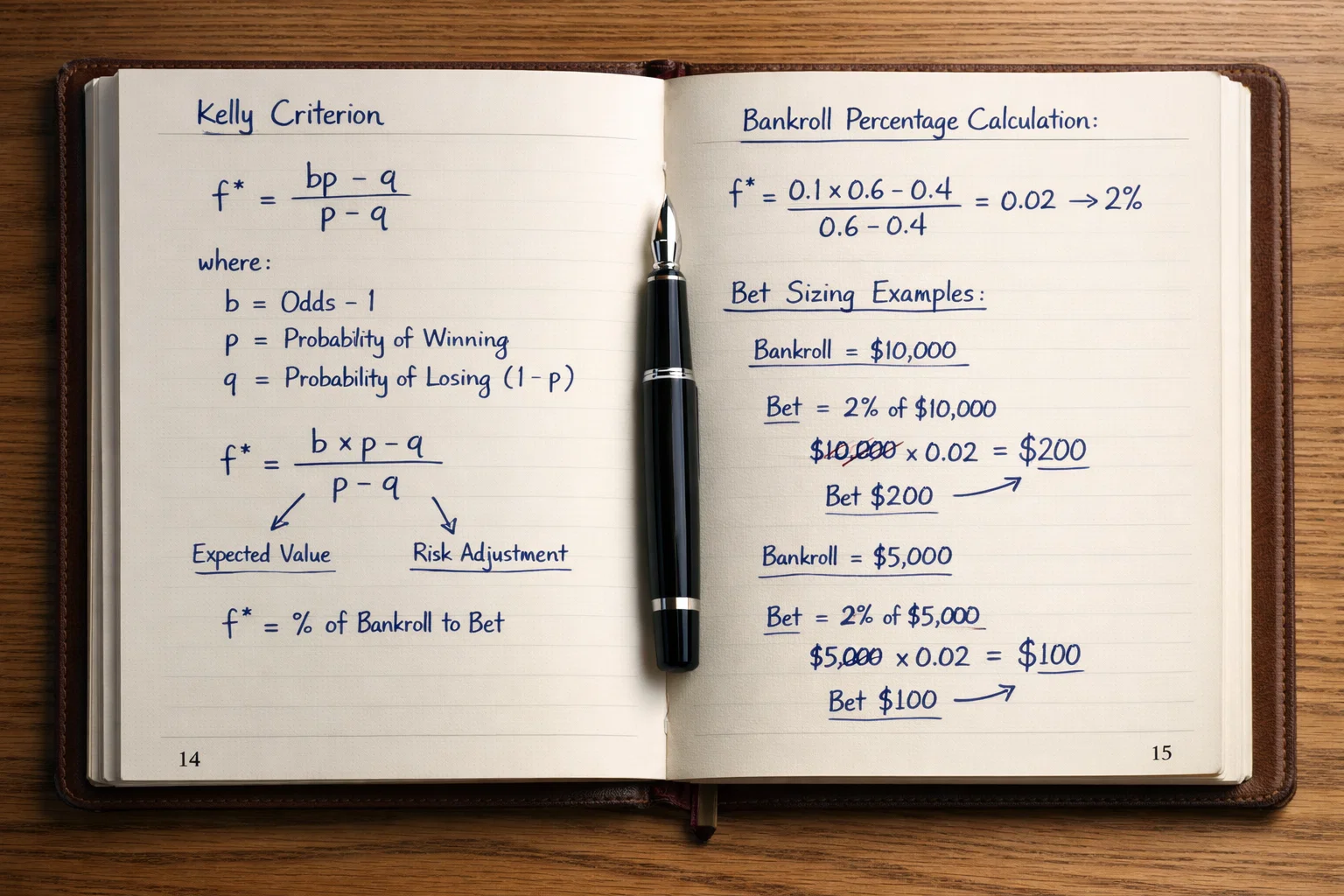
Once you have identified a value bet, the next question is how much to stake. Bet too small and you leave profit on the table. Bet too large and a normal losing streak can devastate your bankroll. The Kelly Criterion provides a mathematical answer to this optimization problem, though it requires careful application in real-world betting.
Formula Explained
The Kelly formula calculates optimal bet size as a percentage of your bankroll: Kelly % equals (bp minus q) divided by b, where b is the decimal odds minus 1, p is your probability of winning, and q is your probability of losing (which equals 1 minus p).
If you estimate a team at 55% to win and the decimal odds are 2.00, then b equals 1, p equals 0.55, and q equals 0.45. Kelly % equals (1 times 0.55 minus 0.45) divided by 1, which equals 0.10 or 10% of your bankroll. According to pure Kelly, you should stake 10% of your bankroll on this bet.
The intuition behind Kelly is elegant: it maximizes the logarithm of wealth, which means maximizing long-term growth rate. Betting more than Kelly increases short-term variance without increasing long-term growth. Betting less than Kelly is safer but slower. The Kelly amount represents the sweet spot where you are betting aggressively but not recklessly.
Fractional Kelly Approach
Pure Kelly betting is too aggressive for most practical purposes. The formula assumes you know the true probability exactly, which you never do. It produces stake sizes that can feel enormous on perceived edges. Most importantly, it tolerates significant drawdowns that many bettors find psychologically unbearable.
The solution is fractional Kelly, where you multiply the Kelly stake by some fraction, typically between 0.25 and 0.5. If Kelly says to bet 10% of your bankroll, fractional Kelly at 0.5 says to bet 5%. This reduces volatility substantially while still capturing most of the long-term growth benefit.
Half Kelly is a common choice among professional bettors. Quarter Kelly provides even more safety and is suitable for those still developing their probability estimation skills. The exact fraction matters less than consistency: pick a fraction that lets you sleep at night and stick with it across all your value bets.
When to Use Kelly
Kelly works best when you have reliable probability estimates and sufficient bankroll to withstand variance. It is not suitable for casual bettors who make a few wagers per week based on gut feelings. The formula demands accurate inputs, and garbage probability estimates produce garbage stake recommendations.
Before applying Kelly, honestly assess whether you can estimate probabilities within a few percentage points of accuracy. If not, fixed unit betting might be more appropriate until you develop that skill. Kelly amplifies both correct and incorrect probability estimates, so using it prematurely can accelerate losses rather than gains.
Kelly also assumes you can make many bets at similar edges over time. If you only find a handful of value opportunities per month, the variance within any reasonable timeframe will overwhelm the expected growth, and you will not see the elegant theoretical results that make Kelly appealing on paper.
Bankroll Management Systems

Regardless of whether you use Kelly or another staking method, bankroll management is the unsexy discipline that keeps bettors alive through inevitable downturns. Many sharp bettors with genuine edges go broke because they staked too aggressively, while more modest talents survive and profit through careful bankroll control.
Fixed Unit Betting
The simplest bankroll management approach is fixed unit betting: every bet is the same size, typically 1% to 3% of your starting bankroll. If you begin with $1,000 and use 2% units, every bet is $20 regardless of how confident you feel about any particular wager.
Fixed units remove the temptation to bet larger on perceived locks, which often disappoint and create outsized losses. They create consistency in your records, making it easier to analyze whether your betting approach is working. And they ensure that no single loss significantly damages your bankroll.
The drawback is that fixed units do not optimize for edge strength. A bet with 10% expected value receives the same stake as a bet with 2% expected value, which is mathematically inefficient. But for bettors who struggle with discipline or are still developing probability estimation skills, this inefficiency is worth the psychological benefit of simplicity.
Percentage-Based Staking
Percentage-based staking adjusts bet size based on current bankroll rather than starting bankroll. If you begin with $1,000 using 2% stakes, your first bet is $20. If you win several bets and grow to $1,200, your stakes increase to $24. If you lose and drop to $800, your stakes decrease to $16.
This approach has theoretical advantages: you bet more when winning and less when losing, which mathematically maximizes long-term growth. It ensures you never go completely broke since your stakes shrink as your bankroll shrinks. And it allows your betting to scale naturally with success.
The psychological challenge is that winning streaks feel less rewarding because each win represents the same percentage despite larger absolute returns. Conversely, losing streaks feel worse because your stakes continually decrease, making recovery seem increasingly difficult. Some bettors find this dynamic demoralizing even when it is mathematically optimal.
Setting Loss Limits
Professional bettors set strict loss limits that trigger a pause in betting activity. A common approach is stopping after losing 5% to 10% of your bankroll within a single day or week. This prevents emotional decision-making during losing streaks when the temptation to chase losses is strongest.
Loss limits acknowledge that even sound strategies experience variance. Losing five bets in a row happens regularly even with a 55% win rate. During those stretches, continuing to bet requires confidence that your edge is real and that the losses are normal variance rather than signals of a flawed approach. Taking a break provides time to review your recent bets objectively.
Some bettors also set win limits, stepping away after a particularly successful session to avoid the overconfidence that often follows. The reasoning is that we are prone to poor decisions both when frustrated by losses and when elated by wins. Neutral states produce better judgment, so leaving the markets during emotional extremes makes sense.
Specialization Strategy
The football betting market is vast, covering dozens of leagues across six continents with hundreds of matches every week. Attempting to find value across this entire landscape is nearly impossible. The bookmakers have armies of analysts tracking everything. Your edge, if you have one, exists in specific niches where your knowledge exceeds the market’s knowledge.
Benefits of League Focus
Specializing in one or two leagues allows you to develop genuine expertise that casual bettors and even some bookmakers lack. You watch every match, follow team news religiously, understand managerial tactics, know which players perform in big moments and which wilt under pressure. This depth of knowledge is impossible to maintain across many leagues simultaneously.
Narrow focus also means you can track line movements and market behavior in your chosen leagues. You learn which opening lines tend to move and in which direction. You recognize when sharp money is entering a market versus public money. These second-order insights compound your primary analytical edge.
The emotional benefit of specialization should not be underestimated either. Betting on leagues you genuinely enjoy watching makes the research process sustainable. Grinding through statistics for leagues you do not care about leads to burnout and sloppy analysis. Engaged bettors make better bettors.
Building Knowledge Edge
Start with a league you already follow and formalize your knowledge acquisition. Create a system for tracking team performance, injuries, suspensions, and tactical patterns. Watch matches with an analytical eye, noting details that might not appear in statistics but affect outcomes.
Develop relationships with local sources if possible. Fans and journalists who follow a league daily often have insights that take weeks to filter into international markets. A key player nursing a minor injury might not make headlines but could significantly affect a team’s performance. Being plugged into the local conversation provides information edge.
Test your knowledge by making predictions without stakes before you start betting real money. If you can predict outcomes at rates better than the implied odds suggest over fifty or a hundred matches, you have evidence that your knowledge translates into betting edge. If not, more research is needed before you risk your bankroll.
Recommended Leagues for Beginners
Major leagues like the English Premier League and Spanish La Liga are heavily analyzed, making value harder to find. But they also offer the most information and are easiest to follow for new bettors. Starting with a major league lets you learn the process of analytical betting even if edge is slim.
Second-tier leagues in major football countries often provide better value opportunities. The English Championship, German 2. Bundesliga, and Italian Serie B receive less attention from sharp bettors while still having abundant information available. The trade-off between analysis depth and market efficiency is often favorable in these leagues.
Smaller European leagues and cup competitions can offer significant value but require more effort to research. If you have genuine connection to a league, perhaps through ancestry or language skills, that is an excellent specialization candidate. Your ability to consume local media that English-speaking bettors cannot access becomes a sustainable edge.
Statistical Approach to Football Betting

Modern football analytics has produced a wealth of metrics that bettors can use to inform their decisions. Statistics alone do not guarantee profit, but understanding what numbers reveal and what they conceal makes you a more sophisticated bettor.
Key Metrics
Expected goals (xG) measures the quality of chances a team creates and concedes, based on the probability that a shot from a given location becomes a goal. A team with high xG and low actual goals is probably unlucky and may regress upward. A team outperforming their xG significantly is probably lucky and may regress downward.
Expected goals against (xGA) applies the same logic to defensive performance. Teams conceding fewer goals than their xGA suggests have been fortunate with opponent finishing. This luck tends to reverse, making them potentially overvalued in betting markets.
Passes per defensive action (PPDA) measures pressing intensity. Lower numbers indicate more aggressive pressing. This metric helps identify tactical mismatches: a high-pressing team facing an opponent that struggles under pressure might overperform expectations.
Data Sources
Quality data is increasingly accessible to individual bettors. Sites like FBref and Understat provide free xG data for major European leagues. Transfermarkt offers comprehensive injury and squad information. Sofascore and Whoscored provide detailed match statistics shortly after games conclude.
Paid services offer deeper data including player-level metrics, detailed shot maps, and proprietary models. Whether these justify their cost depends on how seriously you approach betting and how much edge you need to find. For recreational bettors, free sources typically suffice. For those treating betting as a side business, paid data might be a worthwhile investment.
Whatever sources you use, consistency matters. Comparing xG from two different providers produces confusion because calculation methods vary. Choose one source for each metric and stick with it so your comparisons over time remain valid.
Building Your Own Model
The most successful data-driven bettors build proprietary models that combine multiple metrics to produce probability estimates. These models might weight xG, recent form, home advantage, rest days, and head-to-head history to output win, draw, and loss probabilities for any match.
Building a model requires statistical knowledge and programming ability, typically in Python or R. You need historical data to train and validate your model, then ongoing data to run predictions. The process is time-consuming and intellectually demanding. It is not for everyone, but for those with the skills, it represents the highest ceiling for edge in football betting.
Even simple models can identify opportunities that gut-feeling bettors miss. A basic xG-based model that compares expected performance to actual results over the past ten matches can flag teams likely to regress in either direction. This is not sophisticated by professional standards but outperforms most recreational approaches.
Limitations of Statistics
Statistics describe what happened; they do not perfectly predict what will happen. Football involves low-scoring events with high variance, meaning random chance plays a larger role than in higher-scoring sports. A single goalkeeper mistake or deflected shot can decide a match regardless of what xG suggests should happen.
Contextual factors that statistics miss can be decisive. Player motivation varies based on season circumstances that numbers cannot capture. Managerial changes disrupt tactical patterns that historical data still reflects. International breaks interrupt form in ways that show up only after matches resume.
Use statistics as one input among many rather than as an oracle that replaces judgment. The bettors who thrive combine statistical literacy with contextual awareness, using numbers to inform but not dictate their decisions.
Avoiding Strategy Pitfalls

Even sound strategies fail when implemented poorly. The most common pitfalls involve overconfidence, impatience, and the human tendency to see patterns where none exist.
Over-Optimization
Building a betting model using historical data creates temptation to tweak parameters until the model would have crushed the market over the past several seasons. This is overfitting: the model captures noise rather than signal and fails to generalize to future matches.
Guard against over-optimization by testing your model on data it has never seen. Divide historical data into training and validation sets. Build your model on the training set, then evaluate performance on the validation set. If performance drops substantially, your model is overfit and needs simplification.
Simple models often outperform complex models in betting because they generalize better. A model with three inputs might capture 80% of the value while being robust. A model with thirty inputs might capture 95% of historical value but collapse when conditions shift slightly.
Ignoring Variance
Even a 55% win rate produces losing streaks of seven or eight bets with regularity over a few hundred wagers. This is not failure; it is normal variance. Bettors who do not understand variance abandon profitable strategies during entirely expected downturns, locking in losses that would have reversed with patience.
Before starting any betting strategy, simulate its expected variance using your probability estimates. Understand how often you will experience losing weeks, losing months, and significant drawdowns. When those inevitable rough patches arrive, you will have the context to recognize them as normal rather than catastrophic.
Variance cuts both ways. A 45% win rate that should lose money over time will occasionally produce winning months that create false confidence. If your results are significantly better than expected, be humble rather than triumphant. Luck cannot be counted on to continue.
Strategy Switching Too Often
The worst possible approach is switching strategies every time results disappoint. You never give any strategy enough time to demonstrate whether it works. You accumulate losses across multiple abandoned approaches rather than consolidating gains from one sound approach.
Commit to a strategy for a defined sample size, typically at least a hundred bets, before evaluating whether it works. Track expected results versus actual results. If actual results fall within the expected variance range, the strategy might be sound despite losses. If actual results fall well below expected, more investigation is warranted.
Even then, avoid wholesale abandonment. Perhaps one element of your strategy is flawed while others are sound. Diagnose the specific problem rather than discarding everything and starting fresh. Iteration beats revolution in strategy development.
Conclusion
Profitable football betting requires strategy, discipline, and realistic expectations. Value betting provides the mathematical foundation: find bets where implied probability underestimates true probability, and long-term profit follows. The Kelly Criterion and other bankroll management systems protect you through inevitable losing streaks while maximizing growth during winning periods.
Specialization beats broad surface-level coverage. Deep knowledge of one league trumps shallow knowledge of many. Statistical analysis informs your probability estimates but cannot replace contextual judgment. The most successful bettors combine quantitative rigor with qualitative insight, using each to check the other.
Avoid the pitfalls that claim most aspiring sharp bettors: over-optimizing models to historical data, failing to appreciate variance, and abandoning strategies before giving them fair evaluation. These behavioral errors destroy more bankrolls than bad luck ever could.
Start small, track everything, and approach betting as a skill to develop rather than a shortcut to wealth. The strategies in this guide work, but they work slowly and require sustained effort. Those who commit to the process and resist the temptation to gamble will find that football betting can be not just entertaining but genuinely profitable over time.
Elevate your handicapping skills by following the daily insights provided by our expert football betting guide.
