

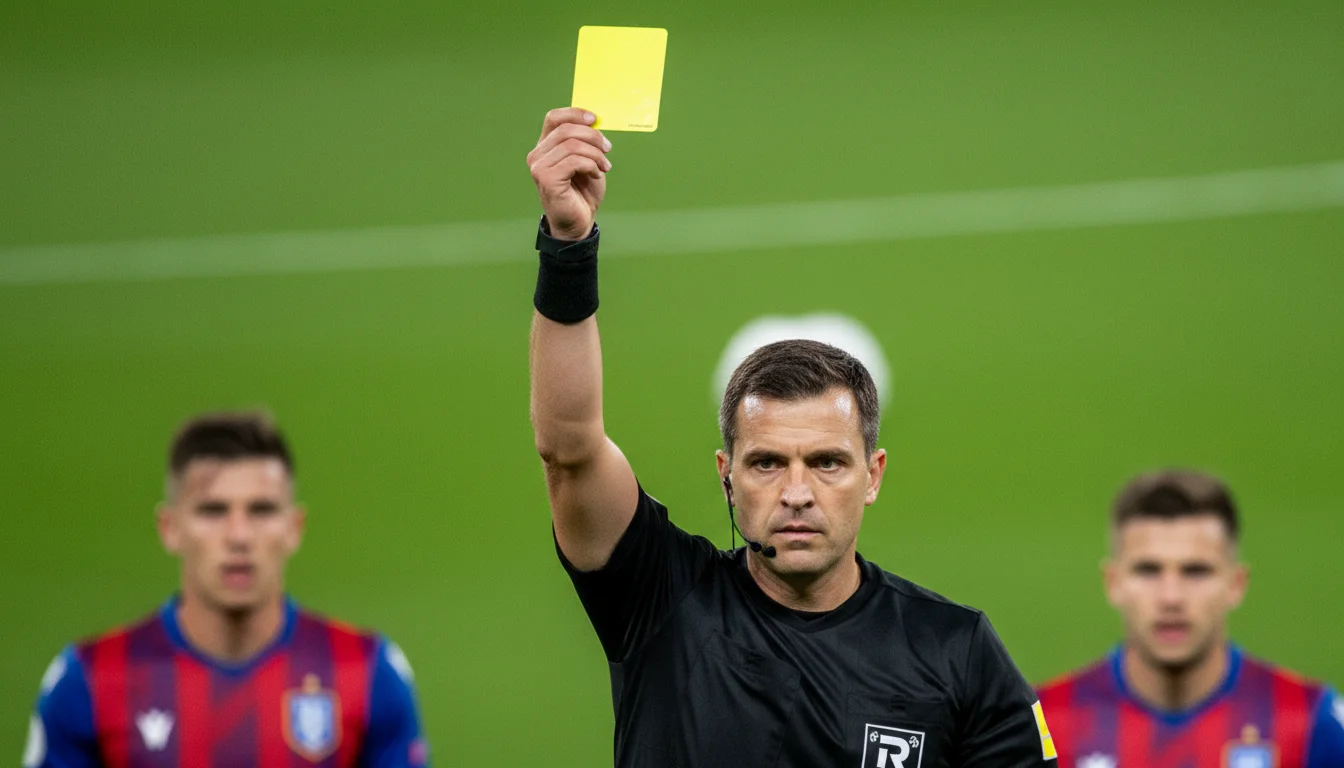
Yellow and red cards are the punctuation marks of a football match. A crunching tackle, a cynical pullback, a moment of dissent — and the referee reaches into his pocket. For most viewers, cards are minor interruptions in the flow of the game. For a growing number of bettors, they are the foundation of an entire market category that offers some of the widest margins for exploitation in football betting.
Cards betting — also called bookings betting — has evolved from a niche curiosity into a standard offering at most major sportsbooks. The markets cover everything from total cards in a match to whether a specific player will receive a booking. The appeal is similar to corners betting: card counts are driven by identifiable patterns, the sportsbook’s models are less sophisticated than for goals-based markets, and the public pays minimal attention, creating opportunities for bettors willing to dig into the data.
Primary Football Bookings Markets
The most common bookings market is the total cards over/under. The sportsbook sets a line for the total number of cards shown in the match — typically between 3.5 and 5.5 in most European leagues — and you bet over or under. Some sportsbooks use a booking points system instead, assigning 10 points for a yellow card and 25 for a red card, with the total line set accordingly (common lines range from 30.5 to 50.5 booking points).
Team cards over/under isolates one team’s card count. If you believe a specific team will be particularly aggressive or undisciplined in a given match, you can target their individual booking line without worrying about the other side’s card count.
Player cards is a market where you bet on whether a named individual will receive a yellow or red card during the match. This is a high-odds market — most individual players receive a card in only 10-25% of their appearances — but it rewards deep knowledge of player tendencies, positional roles, and matchup dynamics.
Card handicaps mirror point-spread betting. One team is given a cards advantage or disadvantage, and you bet on the adjusted card count. If a defensive, foul-heavy team is given a -1.5 card handicap, they need to receive two or more additional cards than their opponent for the over to hit.
First card and card timing markets ask you to predict which team will receive the first booking or in which time bracket (0-30 minutes, 31-60 minutes, 61-90 minutes) the first card will appear. These are lower-liquidity markets with wider margins but can offer value for bettors who understand match tempo patterns.
What Drives Card Counts
Cards are not random, even though they can feel that way in the moment. Several systematic factors influence how many cards a match produces, and understanding them is the foundation of any bookings betting strategy.
Referee assignment is the single most important variable. Different referees have dramatically different card-issuing tendencies. In any given league, the strictest referee might average 5 or 6 cards per match while the most lenient averages 2 or 3. This range is enormous and dwarfs most other factors. Before analyzing anything else about a match, check who the referee is and look at their season card averages. Some sportsbooks release their lines before the referee is announced, which creates a window of opportunity — if a strict referee is assigned and the line was set assuming an average official, the over becomes more attractive.
Match intensity and rivalry status. Derby matches, relegation six-pointers, and heated cup ties produce more cards than routine mid-season league fixtures. The emotional stakes raise the aggression level, players commit more tactical fouls to break up play, and confrontations are more likely. A typical league match might average 4 cards, but a heated local derby can push that average to 5.5 or higher. The sportsbook adjusts for this, but the adjustment is not always sufficient — particularly for rivalries outside the top tier that the book’s models may not weight heavily.
Tactical fouls and defensive style. Teams that defend with a mid-block or low-block strategy commit fewer fouls than teams that press high, because pressing teams are more often caught out of position and need to foul to stop counterattacks. Conversely, teams facing a press tend to commit more fouls when they lose the ball in dangerous areas. The intersection of attacking and defensive styles — who is pressing, who is sitting deep, who is likely to be chasing the game — shapes the foul and card landscape.
Game state and scoreline dynamics. A match where one team trails in the second half tends to produce more cards because the losing team commits desperate fouls to stop attacks and waste time, while the leading team might earn bookings for time-wasting or cynical play to protect the lead. Matches that are level deep into the second half can go either way — sometimes they remain disciplined, sometimes the frustration boils over.
Exploiting the Bookings Niche
The bookings market is less efficient than most goal-based markets, and the inefficiency is structural rather than temporary. Sportsbooks invest their best modeling resources into the markets that generate the most handle — spreads, totals, moneylines. Bookings markets receive comparatively less attention, which means the lines are softer and the edges are wider for prepared bettors.
The referee factor alone creates persistent value opportunities. Referee assignments in most leagues are announced 48 to 72 hours before kickoff, sometimes after the sportsbook has already posted its bookings lines. When a notoriously strict referee is assigned to a match where the initial line was set assuming an average official, the over on total cards may be underpriced. Similarly, a lenient referee in a match where the book expected a card-heavy affair creates value on the under.
Tracking referee tendencies requires minimal effort but produces outsized returns relative to the time invested. A simple spreadsheet logging each referee’s cards-per-match average, home-versus-away card splits, and any patterns in early versus late bookings gives you a data advantage that most casual bookings bettors lack. Several free football statistics websites publish referee card data by season, making the research even easier.
The timing of your bet matters in bookings markets more than in most others. Because referee announcements come after lines are posted, early movers who check for the referee assignment and act quickly can capture value before the market adjusts. This window is typically a few hours at most — sharp bettors and automated models will push the line once the information is public — but the correction is slower in bookings markets than in spread or total markets because fewer people are watching.
Player-Level Card Analysis
The player cards market is where deep knowledge pays the biggest dividends. Individual booking probabilities are driven by a combination of positional role, playing style, and personal discipline.
Defensive midfielders and fullbacks are the most frequently booked positions in football. They are tasked with stopping opposition attacks, which inherently involves more physical confrontation and more potential for fouls. A defensive midfielder who averages 2.5 fouls per match and has been booked in 30% of his appearances this season is a structurally different proposition from a center-forward who averages 0.8 fouls and has been booked once all year.
Players with high foul rates relative to their card rates are interesting from a betting perspective. Some players commit many fouls but somehow avoid cards — perhaps because their fouls tend to be minor or in non-dangerous areas. Others have a high card-per-foul ratio, meaning they tend to commit fouls that referees deem worthy of punishment. The latter group is more likely to be carded in any given match and may be underpriced in the player card market if the sportsbook’s model weighs foul rate without sufficiently accounting for card-per-foul ratio.
Matchup-specific triggers elevate certain players’ card probabilities in particular games. A right-back assigned to mark a tricky, quick winger is more likely to commit a professional foul than one facing a target-man center-forward. A central midfielder in a derby match where the tempo is high and the tackles are flying has a higher booking probability than the same player in a routine mid-table fixture. These situational adjustments require knowing both the player’s tendencies and the specific context of the match.
Substitutes who enter the match late carry a disproportionate card risk per minute played. Fresh legs often enter with aggressive intent, and a mistimed tackle on a tired opponent in the 75th minute is a common source of bookings. Some sportsbooks offer “to be carded” markets that include substitutes, and betting on a known aggressive substitute who regularly enters in the final quarter of matches can offer value if the book has not fully priced in the intensity of their limited minutes.
The Referee’s Pocket as a Market
Cards betting inverts the usual hierarchy of football analysis. In most markets, the teams are the primary variable and the officials are background noise. In bookings markets, the referee is arguably the most important factor — more predictive of total cards than either team’s tactical profile or the match’s competitive context.
This inversion is why the market remains inefficient. Most bettors and most sportsbook models are built around team analysis. They have sophisticated frameworks for evaluating offensive and defensive quality, form cycles, and injury impacts. Far fewer have sophisticated frameworks for evaluating referee tendencies, and those that do have a persistent advantage.
The opportunity will not last forever. As bookings markets grow in popularity and volume, sportsbooks will invest more resources in their modeling, sharp bettors will police the lines more aggressively, and the inefficiencies will narrow. But in 2026, the market is still young enough and the analytical barrier to entry low enough that a bettor with a referee database, a team-level foul model, and some knowledge of player disciplinary records can find value that simply does not exist in the more crowded goals-based markets. The referee’s pocket is a strange place to look for profit, but strange places are exactly where the best margins tend to hide.
