

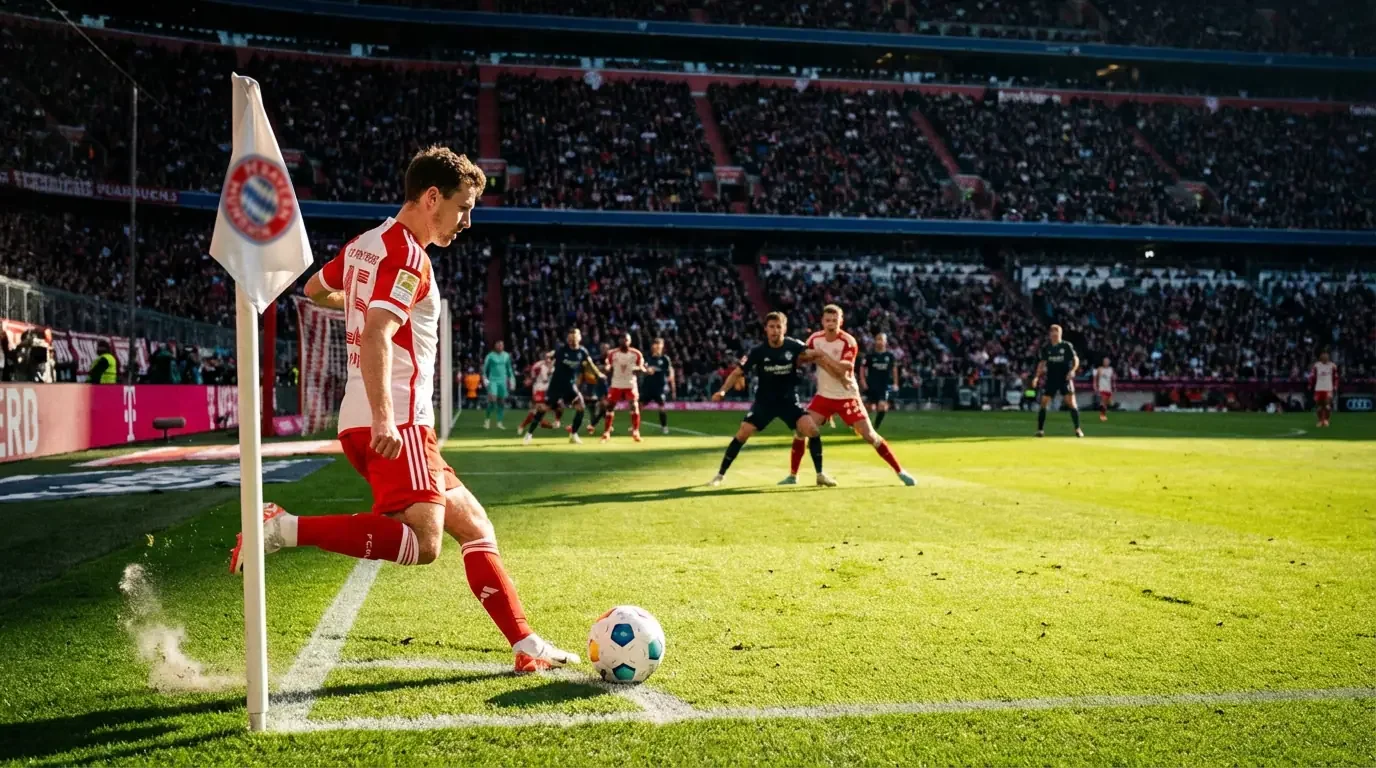
Goals get all the attention, but corners tell you something that goals often do not: which team is generating sustained attacking pressure. A goal can come from a single counterattack, a deflection, or a penalty. Corners accumulate through territorial dominance, repeated attacks on the final third, and blocked shots that deflect behind the goal line. For bettors looking beyond the headline markets, corners offer a rich and underexplored territory where the sportsbook’s models are thinner and the edges are larger.
Corners betting has grown steadily as sportsbooks have expanded their market offerings, and it now sits as a standard feature at most major platforms. The market appeals to bettors who enjoy statistical analysis because corner counts are more predictable than goals — they are more frequent, less subject to individual moments of brilliance or error, and more closely tied to measurable tactical patterns. If you like building models and crunching numbers, corners might be the market where your skills translate most directly into profit.
Primary Football Corner Betting Markets
The most common corners market is the total corners over/under. The sportsbook sets a line for the combined number of corners in the match — typically between 8.5 and 11.5 in top European leagues — and you bet whether the actual count will go over or under that number. The standard vig applies, with both sides usually priced around -110 or 1.90 in decimal.
Team corners over/under isolates one team’s corner count. You might see Manchester City over/under 6.5 corners, allowing you to bet on how many corners a specific team will earn regardless of what the other side does. This market is useful when you have a strong view on one team’s attacking dominance but less certainty about the overall match dynamics.
Corner handicaps work like point spreads but for corners. If Manchester City is given a -2.5 corner handicap against a lower-table side, they need to win the corner count by three or more for your bet to pay out. Corner handicaps are particularly interesting because the relationship between team quality and corner differential is strong — better teams tend to earn more corners consistently.
Race to X corners asks which team will be the first to reach a specified number of corners — typically 3, 5, or 7. This is a first-half-heavy market because the race usually resolves before the 60th or 70th minute. It rewards bettors who understand which teams start matches aggressively and generate early attacking pressure.
Odd/even total corners is a simpler market with a near-50/50 split. You bet on whether the total corner count will be an odd or even number. The edge in this market is razor-thin, but some bettors track historical odd/even splits for specific teams or leagues and find small persistent biases.
What Statistics Drive Corner Counts
Corners are not random. They are produced by identifiable tactical and matchup factors, and the teams that earn the most corners do so for structural reasons that repeat across matches.
Attacking style and territorial dominance. Teams that control possession in the opponent’s half generate more corners because they create more shots, more crosses, and more situations where the defending team deflects the ball behind its own goal line. Possession alone is not a perfect predictor — a team can dominate possession in midfield without threatening the box — but possession in the attacking third correlates strongly with corner counts.
Crossing frequency. Teams that rely on wide play — wingers delivering crosses, overlapping fullbacks whipping balls into the box — earn more corners than teams that attack centrally. A blocked cross is one of the most common sources of a corner kick, so a team that puts in 20 crosses per match will naturally generate more corners than one that puts in 8. This is one of the strongest individual predictors in corner modeling.
Shot volume and shot location. More shots mean more chances for a shot to be deflected wide or over the bar by a defender, resulting in a corner. Teams that take a high volume of shots from around the edge of the box — where defensive blocks are common — tend to have elevated corner counts. Shots from distance, while less likely to score, are more likely to produce corners through deflections.
Opponent defensive approach. The number of corners in a match is not determined solely by the attacking team. A team that defends with a deep block, packing players behind the ball in their own box, will naturally concede more corners because they are blocking more shots and crosses. An opponent that presses high and engages further up the pitch concedes fewer corners because the ball spends less time in their defensive third.
League and Competition Differences in Corner Counts
Average corner counts vary meaningfully across leagues, and failing to account for this is a common mistake in corners betting.
The Premier League typically produces among the highest average corners per match in European football, often around 9.5 to 10.5 per game. The league’s physical, direct style of play generates a high volume of crosses and long-range efforts, both of which translate into corners. The Bundesliga sits in a similar range, driven by its high-pressing, transitional style that creates frequent attacking sequences.
Serie A and Ligue 1 tend to produce fewer corners per match — often closer to 8.5 to 9.5 — reflecting a more controlled, tactically disciplined approach to the game. Italian teams in particular are adept at defending without conceding corners, using positional discipline and controlled clearances to limit set-piece opportunities for the opposition.
La Liga falls in the middle, though the range within the league is wide. Barcelona’s possession-heavy, central-attacking style historically generates fewer corners than you might expect from a dominant team because their attacks tend to come through the middle rather than from crosses. Contrast this with a team like Athletic Bilbao, whose direct, crossing-heavy approach produces consistently high corner counts.
Domestic cup competitions and Champions League matches often produce different corner patterns than league play. In cup ties, especially in later rounds, the stakes and intensity increase, which can push attacking teams to take more risks and generate more corners. Early Champions League group-stage matches, where away teams sometimes play conservatively, can suppress the corner count.
Understanding these baseline differences lets you calibrate your expectations correctly. A total corners line of 10.5 in a Premier League match is set slightly above the league average and may lean toward the under. The same line in a Serie A match is a clearer lean toward the under because the league average is lower. Without this context, you are evaluating lines in a vacuum.
Practical Tips for Corners Betting
Corners markets are less efficient than goals-based markets, but they are not free money. Profitable corners betting requires a systematic approach and a few specific habits.
Build a corners database. Track the corners earned and conceded by every team in the leagues you follow, broken down by home and away. This data is available from statistics providers, and organizing it into a simple spreadsheet gives you a reference point for every match. Over a few months, you will develop an intuitive feel for which teams are corner-heavy and which are corner-light, supplemented by the hard numbers when intuition is not enough.
Pay attention to game state. Corner counts are not evenly distributed across the 90 minutes. They tend to cluster in certain phases — particularly when one team is chasing the game in the final 20 minutes and throwing players forward. A match that is 0-0 at the 70th minute is likely to produce a flurry of corners as both teams push for a winner. A match where one team leads 3-0 at halftime may produce fewer second-half corners because the trailing team loses intensity. Pre-match corners bets should account for the most likely game states, and in-play corners bets should react to the actual flow.
Weight matchup dynamics more than team averages. A team’s season average of 5.5 corners per match is a useful starting point, but the actual count in any given match depends heavily on the opponent. When a high-crossing team faces a deep-block defense, the corner count for the attacking team will spike above their average. When two high-pressing teams meet, the corner count for both might be suppressed because neither team spends extended periods camping in the opponent’s box.
Shop for the best lines. Corner totals and handicaps vary across sportsbooks just like goal-based markets do. A difference of 0.5 corners on the total line — 10.5 at one book versus 11.0 at another — can swing a bet from a loss to a win. This is especially true around the most common totals in the 9-12 range, where a large percentage of matches cluster. Grabbing the better number is free edge.
Consider the referee. This is a factor unique to corners betting. Different referees have slightly different tendencies in how they judge corner-kick situations — particularly on close calls where the ball clips a defender and goes behind the goal line. The effect is small and inconsistent, but in a market where margins are tight, any additional information that tilts the probability is worth incorporating.
The Market Nobody Watches Closely Enough
Corners betting occupies a quiet corner of the sportsbook that most bettors walk past on their way to the goals and spreads. That neglect is precisely its advantage. The sportsbook devotes fewer modeling resources to corners than to match outcomes. The betting public pays less attention, which means less sharp money policing the lines. And the underlying data — crossing rates, shot volumes, defensive blocking tendencies — is publicly available to anyone willing to compile and analyze it.
This does not make corners a guaranteed profit center. The vig still exists, the variance is real, and a model is only as good as the data and logic behind it. But compared to the ruthlessly efficient spread and total markets, corners offer a better chance of finding consistent mispricing for the bettor who puts in the work. The ball going out for a corner might be one of the least dramatic events in football, but for the right kind of bettor, it is one of the most interesting.
