

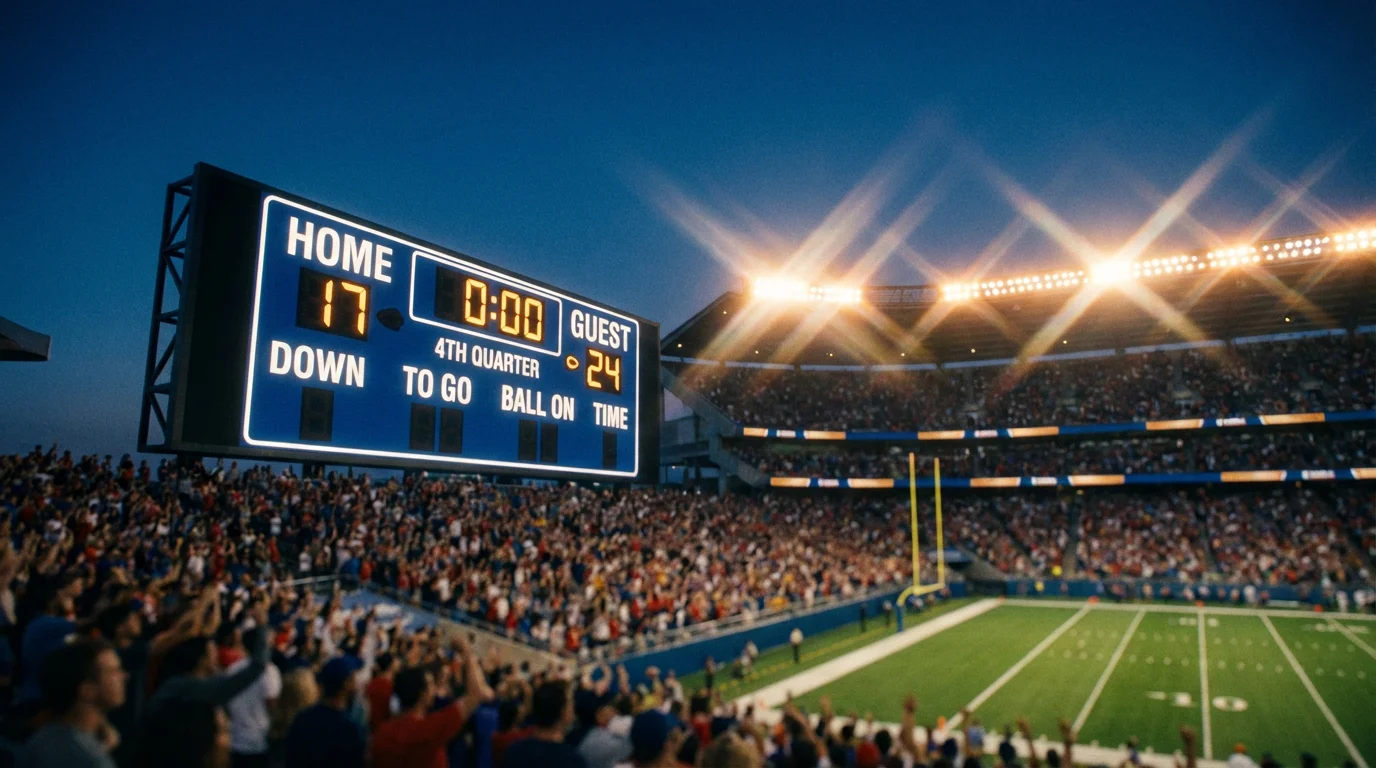
Some football bets are about who wins. Over/under bets are about how the game unfolds — specifically, how many combined points (or goals) both teams produce. You do not need to pick a side. You do not care who covers or who lifts the trophy. Your only question is whether the total score will be higher or lower than the number the sportsbook has set.
Totals betting, as it is formally known, is one of the cleanest markets in football. It strips away the tribalism and narrative noise that clouds so many spread and moneyline decisions. You are left with a single number and a binary choice: over or under. That simplicity is both the appeal and the trap, because the analysis behind a good totals bet is anything but simple.
Mechanics of Football Totals Betting
A sportsbook sets a total for every football game, representing the expected combined score of both teams. In an NFL matchup, you might see a total of 47.5. In a Premier League fixture, it might be 2.5 goals. Your job is to decide whether the actual combined score will go over or under that number.
If you bet the over at 47.5 in an NFL game and the final score is 28-24 (52 total points), you win. If the final score is 17-13 (30 total points), you lose. The half-point ensures there is no push — the result is always decisive. Some totals in American football are set at whole numbers like 44 or 48, which means a combined score landing exactly on that number results in a push and your stake is returned.
The standard vig on totals is the same as on spreads — typically -110 on each side. As with spread markets, the line moves in response to betting action and new information. If a star quarterback is ruled out, the total might drop by 2-3 points. If weather conditions suggest a high-scoring affair, the number might rise. These adjustments happen constantly between the time the line opens and kickoff.
One detail that trips up beginners: overtime counts. In the NFL, if a game goes to overtime and the additional scoring pushes the total over the line, the over wins. This is worth keeping in mind because overtime games are not exceptionally rare — about 5% of NFL regular-season games go to OT in a typical year.
What Drives a Total Up or Down
The sportsbook does not pull totals out of thin air. They are derived from power ratings, historical data, and a web of situational factors. Understanding those factors is the first step toward finding edges in the market.
Offensive output is the most obvious driver. Teams that average 30 points per game naturally push totals higher when paired together. But raw scoring averages can mislead. A team that scored 45 points against a bottom-five defense and 10 against a top-five defense averages 27.5 — a number that describes neither game accurately. Context matters more than the mean.
Defensive quality is the other side of the equation and is often undervalued by casual bettors. A matchup between two elite defenses might feature a total of 38 or 39 in the NFL, reflecting the expectation that neither offense will move the ball efficiently. Conversely, two porous defenses meeting each other can produce totals north of 55.
Pace of play is critical in both American football and soccer. In the NFL, teams that run the ball heavily and control the clock reduce the total number of possessions, which naturally limits scoring opportunities. A run-heavy team facing another run-heavy team creates a game environment where overs are less likely even if both offenses are competent. In soccer, teams that press high and create turnovers in the attacking third tend to generate more shots and more goals, pushing the expected total upward.
Venue effects are real and measurable. Denver’s altitude has historically correlated with higher-scoring NFL games. Certain Premier League grounds produce more goals on average due to pitch dimensions, crowd energy, or the attacking style of the home side. These effects are small individually but meaningful over a full season of bets.
Weather: The Totals Bettor’s Secret Weapon
Weather is the single most underrated factor in totals betting, particularly in outdoor American football. Wind, rain, snow, and extreme cold all suppress scoring, and the market does not always adjust quickly enough.
Wind is the big one. Sustained winds above 15-20 mph significantly reduce passing efficiency, and passing is how most NFL points are scored. A game played in 25 mph gusts is a fundamentally different event than the same matchup in a dome. The total might drop a point or two when wind is in the forecast, but historical data suggests the actual impact on scoring is often larger than the adjustment. This creates a persistent lean toward unders in high-wind games.
Rain and snow affect footing, ball security, and passing accuracy. Heavy rain games tend to produce more turnovers and fewer sustained drives, dragging the total down. Snow games are trickier — light snow can be largely cosmetic, but heavy snowfall on an untreated field changes the game completely. Cold weather alone, without wind or precipitation, has a smaller effect, but extreme cold (below 10°F) does correlate with reduced scoring in outdoor NFL venues.
For soccer, weather impacts are more subtle but still present. A waterlogged pitch slows the ball and makes precise passing harder, often leading to scrappier, lower-scoring matches. Extreme heat can reduce work rate in the second half, potentially limiting late-game goals. These factors will not turn a 2.5-goal total into a 1.5, but they influence whether the margin tilts over or under.
Strategies for Betting the Over
Betting overs successfully requires identifying games where the scoring conditions are better than the number suggests. A few situations consistently produce over-friendly environments.
Games between teams with poor defenses and competent offenses are the most straightforward over candidates. When both defenses rank in the bottom third of their league, the expected scoring is naturally elevated. The key is checking whether the total already reflects this — if the sportsbook has set the number at 55, the bad defenses are already priced in.
Divisional rivalry games with high stakes can produce overs, especially in the NFL playoffs or the closing weeks of a soccer season. When both teams are motivated and attacking, the conservative tendencies that keep regular-season games tight sometimes disappear. But this is a tendency, not a rule, and should be corroborated by matchup-specific analysis.
Look for games where the total has moved down due to public action but the underlying metrics have not changed. If a total opens at 48 and drops to 46 because of one-sided under money, but the offensive and defensive metrics still suggest 48 is the fair number, the over at 46 represents value.
Strategies for Betting the Under
Unders are less popular with casual bettors because they are boring to watch. Nobody is cheering for fewer points. That unpopularity is precisely what creates value — the public leans toward overs, and sportsbooks adjust by shading totals slightly higher, which tilts the mathematical edge toward unders over large samples.
Defensive matchups are the obvious under play. When two top-10 defenses meet, the game flow tends toward punts, field goals, and long clock-draining drives. The key metric is not just points allowed but yards per play, which captures defensive efficiency better than raw scoring does.
Pace mismatches can create under-friendly situations even when one team has a strong offense. If a high-powered passing attack faces a team that controls the clock with a grinding rushing game, the total number of possessions might be lower than expected. Fewer possessions mean fewer scoring opportunities, even if one team is efficient when it does have the ball.
Monday and Thursday night NFL games have historically trended under relative to the number, potentially because of short preparation windows and fatigue. This is one of those patterns that sportsbooks are aware of in 2026 and may have adjusted for, so it is worth verifying against recent data rather than assuming it still holds.
The Math Under the Surface
Over/under betting is, at its core, an exercise in estimating distributions. The sportsbook sets a single number, but the actual range of possible outcomes is wide. An NFL game with a total of 44 might finish anywhere from 13-10 to 35-31. Your job is not to predict the exact score — it is to decide whether the probability-weighted distribution of outcomes skews above or below the posted number.
This means the best totals bettors spend less time thinking about what will happen and more time thinking about what could happen across a range of scenarios. They ask whether the conditions of the game — matchup quality, pace, weather, motivation — make the upper or lower end of the scoring spectrum more likely than the line implies. When you get that assessment right more often than wrong, the math takes care of the rest.
